Questo o Quello? A complete guide to Italian demonstrative adjectives

Are you unsure whether to say 'questo libro' or 'quel libro'? You're not alone! The difference between  questo  and  quello  confuses many learners. In this guide, you'll learn the simple rule, see plenty of real-life examples, and practice with free exercises. In Italian,  questo  (this) and  quello  (that) are called  demonstrative adjectives  because they  demonstrate  where something is. Use  questo  for things near you (like a book in your hand) and  quello  for things farther away (like a book on a shelf across the room). Getting them right will make your Italian sound instantly more natural. Demonstrative adjectives provide important information in the context of everyday communication, helping to indicate whether the object or person being talked about is near or far from the speaker or listener. For example, when shopping for groceries, we can say 'Voglio comprare questo pane' to refer to one close ...

Parola del giorno: CAMERA

CAMERA

Significato

La parola camera significa una stanza della casa, di solito dove si dorme. Può anche indicare una stanza in un hotel.

Pronuncia

[ˈkaːmera]

Per esempio:
  • La mia camera è grande.

  • Oggi, dormo nella mia camera.


Usi comuni

Camera da letto → Il posto dove dormiamo.
Esempio: La mia camera da letto ha un letto grande.

Camera d’albergo → Lo spazio dove dormiamo in un hotel.
Esempio: Prenoto una camera d’albergo per le vacanze.

Camera singola / doppia → Tipo di spazio dove dormiamo con uno o due letti.
Esempio: Vorrei una camera doppia per me e il mio amico.


Parole correlate

  • Stanza (sostantivo) → Sinonimo di camera, indica un ambiente chiuso in una casa o in un edificio.

Differenza tra 'camera' e 'stanza'

  • Camera  →  Si usa soprattutto per dormire o per gli hotel.
    Esempio: La mia camera ha un letto e un armadio.

  • Stanza  →  È più generico e può indicare qualsiasi ambiente chiuso.
    Esempio: La casa ha cinque stanze.

Per esempio:

  • Nella mia camera ci sono un letto e una scrivania.

  • L’albergo ha molte camere con vista sul mare.

  • Questa stanza è molto luminosa.


Curiosità

In Italia, la camera da letto è spesso un luogo personale e accogliente, con decorazioni, foto e oggetti speciali. Nei piccoli hotel italiani, le camere d’albergo possono essere più piccole rispetto ad altri paesi, ma spesso hanno un’atmosfera calda e familiare.

🎯 E tu? Com’è la tua camera? Descrivila con una frase! 😊

__________________________________________________________________________

If you have any questions or would like to share your learning experience, please leave a comment below. I'm curious to know how you are progressing on your language journey!

You can now download Italian grammar exercises for FREE! 
Check out my other posts to find a variety of resources and tips designed to help you practise and improve your Italian. 

NO subscription or credit card required - just start learning today!


Comments

Popular posts from this blog

Italian word accent - L'accento delle parole in italiano

In Italian, the accent, or tonic syllable, is an essential element for correct pronunciation. The accent determines which syllable within the word should be pronounced more strongly. This can change the meaning of similar words, making the position of the accent an important aspect to master. Why do we say 'ultima', 'penultima' and 'terzultima sillaba'?  In Italian, the terminology used to identify the position of the accent is based on a specific order, always starting with the last syllable. This makes it possible to identify the accented syllable and avoid confusion. When identifying the syllable on which the accent falls, we always start with the last syllable of the word: Ultima : the last syllable. Penultima (second-to-last syllable): the second syllable from the end. Terzultima (third-to-last syllable): the third syllable from the end. Speaking of the position of the accent, saying ' last ' (ultima) or ' second-to-last syllable ' (penu...

Daily routines and reflexive verbs

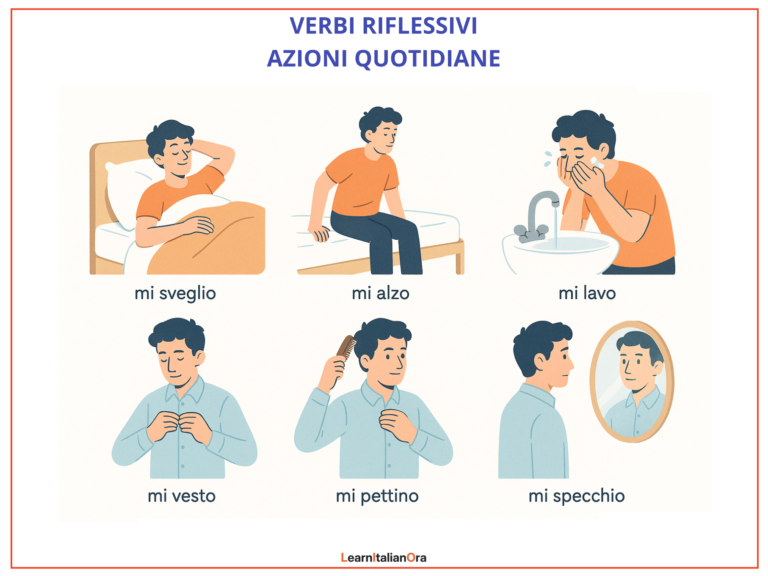
Every day we perform many everyday actions: we wake up, wash, dress, eat, work and go to sleep. But how do we describe these actions in Italian?  Let's see together how to describe our day, step by step, using verbs that express actions do"on ourselves". Reflexive verbs and daily actions Many daily actions use reflexive verbs , which indicate an action that falls on the person who is doing it.  For example: Svegliarsi (to wake up) → Io mi sveglio alle 7:00. (I wake up at 7 a.m.) Alzarsi (to get up) → Tu ti alzi presto? (Do you get up early?) Lavarsi (to wash oneself) → Lui si lava le mani prima di mangiare. (He washes his hands before eating) Vestirsi (to get dressed) → Noi ci vestiamo velocemente. (We get dressed quickly) Rilassarsi (to relax) → Voi vi rilassate la sera? (Do you relax in the evening?) Addormentarsi (to fall asleep) → Loro si addormentano tardi. (They fall asleep late) In Italian, we use reflexive verbs to describe many actions in our daily lives. Th...

Italian Modal Verbs: Potere, Volere, Dovere explained with examples

What are modal verbs in Italian? Modal verbs - potere (can), volere (want) and dovere (must) - are key to expressing yourself in Italian. These verbs allow you to express possibilities, desires and obligations, making them essential tools for anyone learning the language. Thanks to these verbs, you can construct more complex and precise sentences, even at beginner level. Let us now look at the characteristics of each verb, keeping in mind that these modal verbs are irregular and do not follow the typical conjugation patterns of regular verbs. Potere - To express possibility or permission The verb potere is used to indicate that an action is possible , or to ask for or give permission . Examples with Potere: Posso aprire la finestra? (May I open the window?)  - Permission Non posso venire domani. (I can't come tomorrow.) - Possibility Puoi aiutarmi? ( Can you help me?) - Possibility Conjugation of Potere (Present tense) Person Form io posso...