Every day we perform many everyday actions: we wake up, wash, dress, eat, work and go to sleep. But how do we describe these actions in Italian?
Let’s see together how to describe our day, step by step, using verbs that describe actions involving the subject.
Reflexive verbs and daily actions
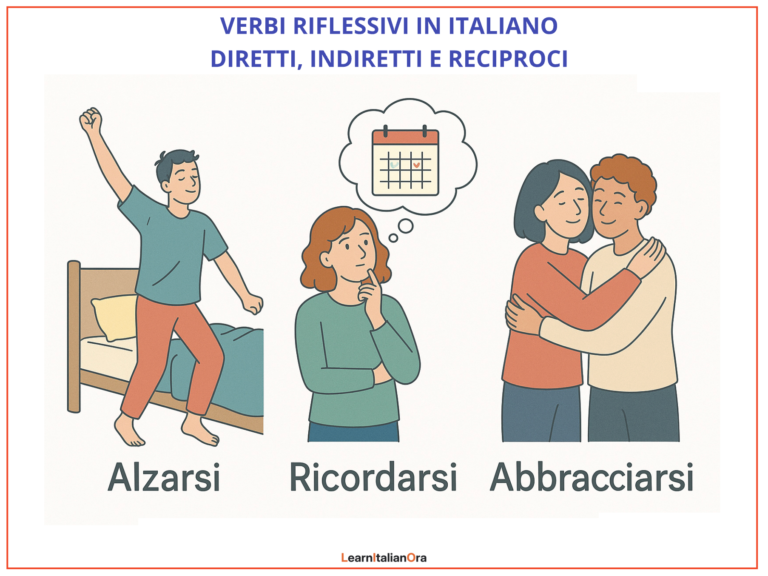
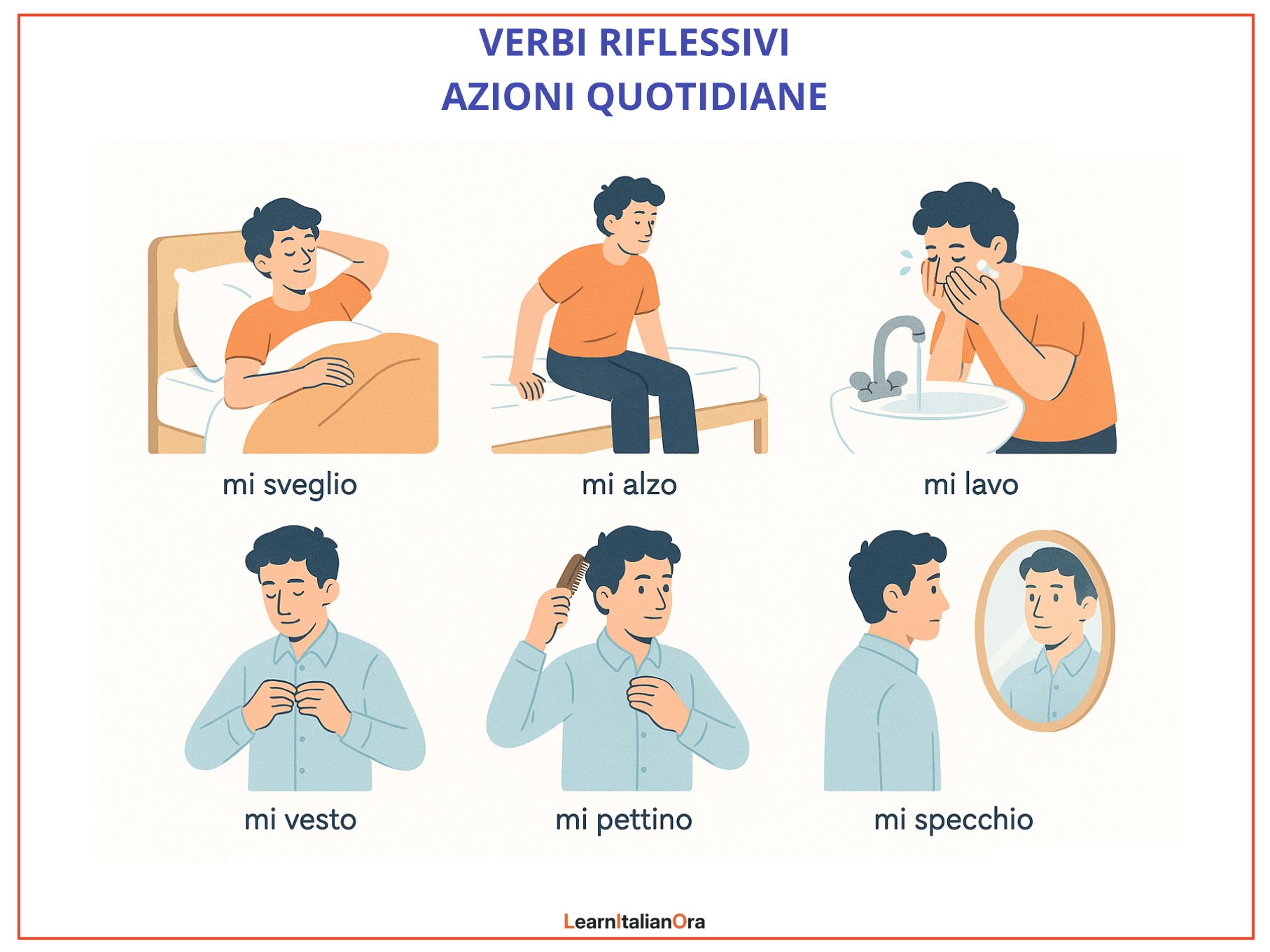
Many daily actions in Italian are expressed with verbs such as svegliarsi, alzarsi and vestirsi. These verbs are used with a reflexive pronoun (mi, ti, si, ci, vi, si).
For example:
- Svegliarsi (to wake up) → Io mi sveglio alle 7:00. (I wake up at 7 a.m.)
- Alzarsi (to get up) → Tu ti alzi presto? (Do you get up early?)
- Lavarsi (to wash oneself) → Lui si lava le mani prima di mangiare. (He washes his hands before eating)
- Vestirsi (to get dressed) → Noi ci vestiamo velocemente. (We get dressed quickly)
- Rilassarsi (to relax) → Voi vi rilassate la sera? (Do you relax in the evening?)
- Addormentarsi (to fall asleep) → Loro si addormentano tardi. (They fall asleep late)
Many common daily-routine verbs are used with mi, ti, si, ci, vi or si. Some are true reflexive uses, while others are pronominal verbs. At A1, it is useful to learn forms such as mi sveglio, mi alzo and mi vesto as complete patterns.
What are reflexive verbs?
In this lesson, focus first on the pattern: the pronoun changes with the subject (mi, ti, si, ci, vi, si) and the verb is conjugated normally. For example: io mi sveglio, tu ti svegli, lei si sveglia.
Click here to learn more about this topic.
A reminder of the use of reflexive pronouns:
io → mi
tu → ti
lui/lei → si
noi → ci
voi → vi
loro → si
These pronouns go before the verb when it is conjugated. The verb “svegliarsi” in its infinitive form includes the reflexive pronoun “si” at the end. When it is conjugated, the pronoun moves in front of the verb and changes depending on the subject.
Reflexive verbs are made up of two parts:
1. The reflexive pronoun (mi, ti, si, ci, vi, si)
2. The verb conjugated in the correct form (mi sveglio, ti svegli…)
Let’s look at an example with the verb svegliarsi in the present indicative:
Io mi sveglio
Tu ti svegli
Lui/lei si sveglia
Noi ci svegliamo
Voi vi svegliate
Loro si svegliano
The three families of reflexive verbs
Like all Italian verbs, reflexive verbs are divided into three groups based on their infinitive endings (click here to learn more about the three families of verbs in Italian):
–ARE → svegliarsi, alzarsi, lavarsi
–ERE → mettersi, accorgersi, vedersi
–IRE → vestirsi, divertirsi, addormentarsi
Some examples:
-ARE
svegliarsi → mi sveglio, ti svegli, si sveglia, ci svegliamo, vi svegliate, si svegliano
alzarsi → mi alzo, ti alzi, si alza, ci alziamo, vi alzate, si alzano
lavarsi → mi lavo, ti lavi, si lava, ci laviamo, vi lavate, si lavano
-ERE
mettersi → mi metto, ti metti, si mette, ci mettiamo, vi mettete, si mettono
accorgersi → mi accorgo, ti accorgi, si accorge, ci accorgiamo, vi accorgete, si accorgono
vedersi → mi vedo, ti vedi, si vede, ci vediamo, vi vedete, si vedono
-IRE
vestirsi → mi vesto, ti vesti, si veste, ci vestiamo, vi vestite, si vestono
divertirsi → mi diverto, ti diverti, si diverte, ci divertiamo, vi divertite, si divertono
addormentarsi → mi addormento, ti addormenti, si addormenta, ci addormentiamo, vi addormentate, si addormentano
Knowing which family a verb belongs to helps us to conjugate it correctly.
Conjugating verbs after a reflexive pronoun
Now that we have seen how verbs are divided into three groups, let’s see how to apply these rules to correctly conjugate reflexive verb.
When using a reflexive verb, the verb that follows the pronoun must be conjugated according to the correct tense and person. In short, this means that you simply take the conjugation of the regular verb and add the appropriate reflexive pronoun (mi, ti, si, ci, vi, si) before it.
For example, starting with the verb svegliare (to wake someone up), which belongs to the -are verb family. If we conjugate it in the present indicative (without reflexive pronouns), we get:
- io sveglio (I wake someone up)
- tu svegli (you wake someone up)
- lui/lei sveglia (he/she wakes someone up)
To form the reflexive version (svegliarsi – to wake up), we simply add the reflexive pronoun before the verb:
- io mi sveglio (I wake up)
- tu ti svegli (you wake up)
- lui/lei si sveglia (he/she wakes up)
Knowing the three conjugation patterns (-are, -ere, -ire) helps with the present tense. The passato prossimo requires an additional rule: reflexive verbs use essere, and the past participle agrees with the subject:
- io ho svegliato (I woke someone up) → io mi sono svegliato/a (I woke up)
- tu hai svegliato (you woke someone up) → tu ti sei svegliato/a (you woke up)
- lui/lei ha svegliato (he/she woke someone up) → lui/lei si è svegliato/a (he/she woke up)
Knowing the conjugation of the base verb helps you form these patterns, but the meaning of a verb with -si is not always simply the meaning of the same verb plus ‘oneself’.
In summary, knowing which family the verb belongs to allows us to:
- Conjugate correctly the present indicative after the reflexive pronoun (e.g. mi sveglio).
- Recognise that other tenses, such as the passato prossimo, follow additional rules (e.g. mi sono svegliato / mi sono svegliata).
This knowledge is essential for speaking Italian correctly and fluently, both when describing everyday actions and when dealing with other verb tenses in the future.
Describing daily actions
Now let’s put all this information together to talk about our day. Imagine a typical day and try to describe it step by step!
The first step in our day is to wake up (svegliarsi), but watch out! In Italian we say ‘io mi sveglio‘ and not just ‘io sveglio‘ because the action is on us.
After waking up, we get up (ci alziamo) and so on.
For example:
La mattina
- Mi sveglio alle 7:00. (I wake up at 7:00.)
- Mi alzo dal letto. (I get up from bed.)
- Mi lavo il viso e i denti. (I wash my face and teeth.)
- Mi vesto velocemente. (I get dressed quickly.)
During the day we continue with many activities:
Il pomeriggio
- Pranzo alle 13:00 e poi mi riposo un po’. (I have lunch at 1:00 p.m. and then I rest a bit.)
- Mi metto le scarpe e vado a fare una passeggiata. (I put on my shoes and go for a walk.)
- Mi siedo e leggo un libro. (I sit down and read a book.)
- Mi preparo per andare in palestra. (I get ready to go to the gym.)
La sera
- Mi rilasso e guardo la TV. (I relax and watch TV.)
- Mi lavo prima di andare a dormire. (I wash myself before going to sleep.)
- Mi metto il pigiama e vado a letto. (I put on my pyjamas and go to bed.)
- Mi addormento intorno alle 22:00. (I fall asleep around 10:00 p.m.)
In this way, each action is expressed clearly and evenly, using reflexive verbs to emphasise that the actions are performed on ourselves. Following the three-family rule makes it easier to conjugate verbs in the present tense and in other tenses in the future.
Now it’s your turn! Write a short text about your day in Italian. Use at least 5 reflexive verbs, like svegliarsi, vestirsi, rilassarsi. You can use my example to help you!
For example:
Mi sveglio alle 7:30, poi mi lavo il viso e mi vesto. Vado a scuola e studio per tre ore. Dopo pranzo mi rilasso e guardo la televisione. La sera faccio la doccia e vado a letto presto.
(I wake up at 7:30, then I wash my face and get dressed. I go to school and study for three hours. After lunch I relax and watch television. In the evening I take a shower and go to bed early.)
Write your daily routine in the comments using at least 5 reflexive verbs. I’ll read them and help you out!😊
Practise what you’ve learned
Check your understanding, then try again if you need to.
Exercise 1 of 3
Everyday routine vocabulary
Match each expression with its meaning.
svegliarsi
fare colazione
andare al lavoro
pranzare
tornare a casa
cenare
andare a letto
Exercise 2 of 3
Put the day in order
Read Anna’s routine, then put its five activities in order. Anna si sveglia alle 7:00, fa colazione alle 7:30, pranza alle 13:00, cena alle 20:00 e va a letto alle 23:00. Follow Anna’s routine, not your own.
Position 1
Position 2
Position 3
Position 4
Position 5
Exercise 3 of 3
What do you do?
Choose the most suitable activity.
Alle 7:00 apro gli occhi: ___.
Alle 7:30 mangio il primo pasto della giornata: ___.
Alle 13:00 è ora del pasto di mezzogiorno: ___.
Alle 18:00 rientro nella mia abitazione: ___.
Alle 20:00 è ora di cena: ___.
Alle 23:00 mi preparo a dormire: ___.