Discover Italian numbers from 0 to 100
You need numbers to count, tell your age, tell the time and much more. But don’t worry, with a few tricks and a little practice, you’ll be able to remember them in no time! In this lesson I will show you how to memorise numbers from 0 to 100, highlight irregular numbers and explain the rules for forming two-digit numbers.
Numbers from 0 to 10: the foundation
We start with the numbers 0 to 10, which you must learn by heart because they are the basis for all other numbers:
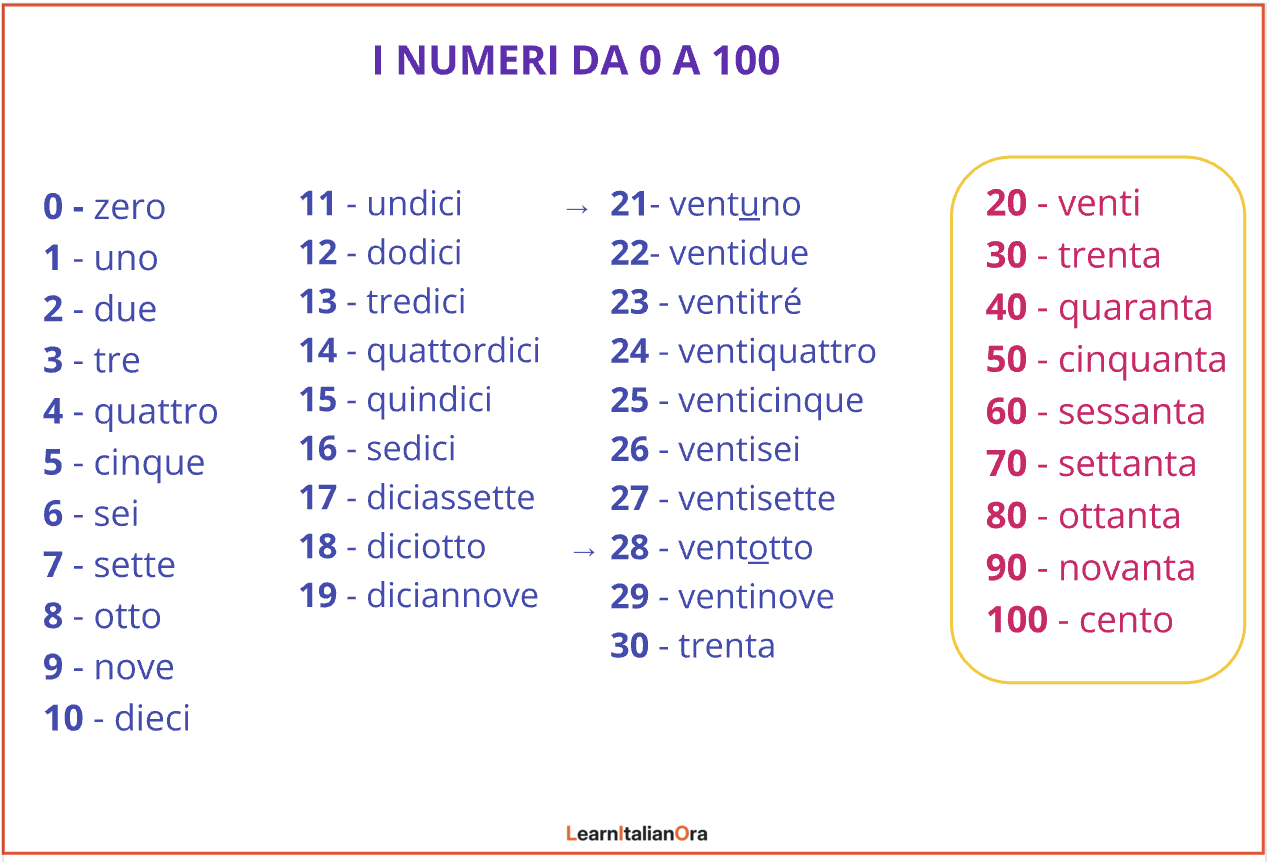
0 – zero
1 – uno
2 – due
3 – tre
4 – quattro
5 – cinque
6 – sei
7 – sette
8 – otto
9 – nove
10 – dieci
Numbers 11 to 19: beware of irregulars
Numbers 11 to 19 need to be learned individually, although they show useful patterns: 11–16 end in -dici, while 17–19 begin with dici-.
You will notice that from number 11 to 16 they end in ‘-dici‘ and from number 17 to 19 they begin with ‘dici-‘.
There is no fixed rule, so repeat them often to memorise them!
11 – undici
12 – dodici
13 – tredici
14 – quattordici
15 – quindici
16 – sedici
17 – diciassette
18 – diciotto
19 – diciannove
Two-digit numbers with zero: tens
Numbers ending in zero are very easy to learn. Here are the most important tens:
20 – venti
30 – trenta
40 – quaranta
50 – cinquanta
60 – sessanta
70 – settanta
80 – ottanta
90 – novanta
100 – cento
Regular’ two-digit numbers: how to join them
For regular two-digit numbers, you can follow a simple rule: just add the tens (20, 30, 40, etc.) to the numbers 1 to 9, making a kind of ‘addition’:
Example
20 + 5 = 25 → venti+cinque → venticinque
40 + 7 = 47 → quaranta+sette→ quarantasette
60 + 9 = 69 → sessanta+nove → sessantanove
70 + 4 = 74 → settanta+quattro→ settantaquattro
Beware of numbers ending in one and eight
When tre is the final element of a compound number, it takes a written accent: ventitré, trentatré, quarantatré.
When numbers end with ‘uno‘ (1) or ‘otto‘ (8), you have to be careful because these words start with a vowel in Italian. If they are joined by a ten (which ends with a vowel), the final vowel of the ten is removed:
Example
20 + 1 = 21 → ventuno (not *ventiuno)
30 + 8 = 38 → trentotto (not *trentaotto)
60 + 1 = 61 → sessantuno (not *sessantauno)
Practical Exercises
Now that you have learnt the rules, try practising!
- Count up to 30 aloud.
- Write the numbers 45, 58, and 91 in Italian.
- Find examples of numbers ending with ‘uno’ and ‘otto’.
Remember, the key to mastering numbers in Italian is constant practice. Repeat, write and use the numbers in your daily life.
Have fun and if you want, write your answers in the comments!
Practise what you’ve learned
Check your understanding, then try again if you need to.
Exercise 1 of 3
Number → word
Choose the correct Italian number.
8
12
17
20
21
28
43
100
Exercise 2 of 3
Put the numbers in order
Put the five numbers in ascending order, from the smallest to the largest.
Position 1
Position 2
Position 3
Position 4
Position 5
Exercise 3 of 3
Numbers in everyday communication
Choose the number that matches the sentence.
Ho ventidue anni.
Costa quindici euro.
Il numero è trentotto.
Siamo in sessanta.
La camera numero ventuno è al secondo piano.
Il libro costa novantanove euro.