Grammar
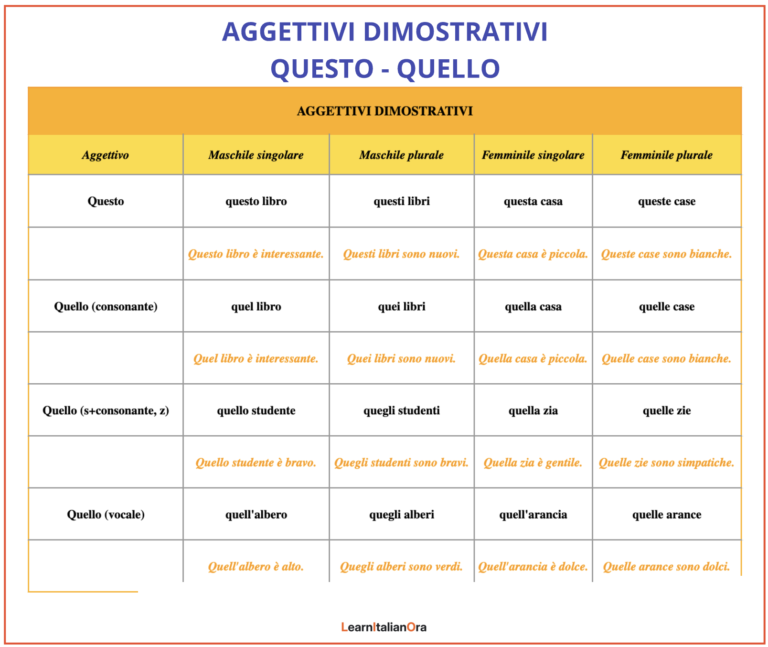
Are you unsure whether to say 'questo libro' or 'quel libro'? You're not alone! The difference between questo and quello confuses many learners. In this guide, you'll learn the simple rule, see plenty of real-life examples, and practise with free exercises.
Read more →
Grammar

Modal verbs - potere (can), volere (want) and dovere (must) - are key to expressing yourself in Italian. These verbs allow you to express possibilities, desires and obligations, making them essential tools for anyone learning the language. Thanks to these verbs, you can construct more complex and precise sentences, even at beginner level. Let us now look at the characteristics of each verb, keeping in mind that these modal verbs are irregular and do not follow the typical conjugation patterns of regular verbs.
Read more →
Grammar
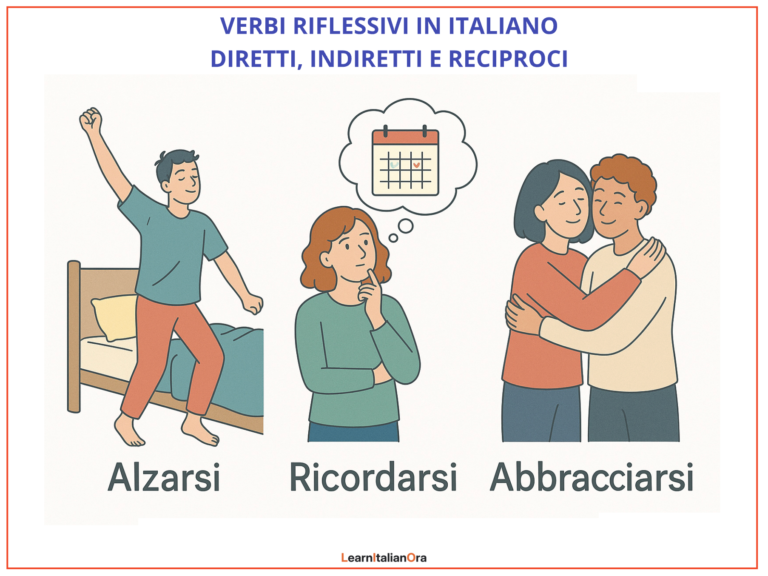
Reflexive verbs (verbi riflessivi) are very common in Italian and can be tricky at first. In this guide, you’ll learn how to use Italian reflexive verbs, including common reflexive verbs in daily life. If you have ever wondered why Italians say mi lavo instead of lavo, or the difference between ricordarsi and ricordare, this post will help you. You will learn: how reflexive verbs are formed;the role of reflexive pronouns (mi, ti, si, ci, vi, si); the difference between direct, indirect and reciprocal verbs and the most common reflexive verbs in daily life.By the end, you’ll be able to use them naturally in everyday conversations.
Read more →
Grammar
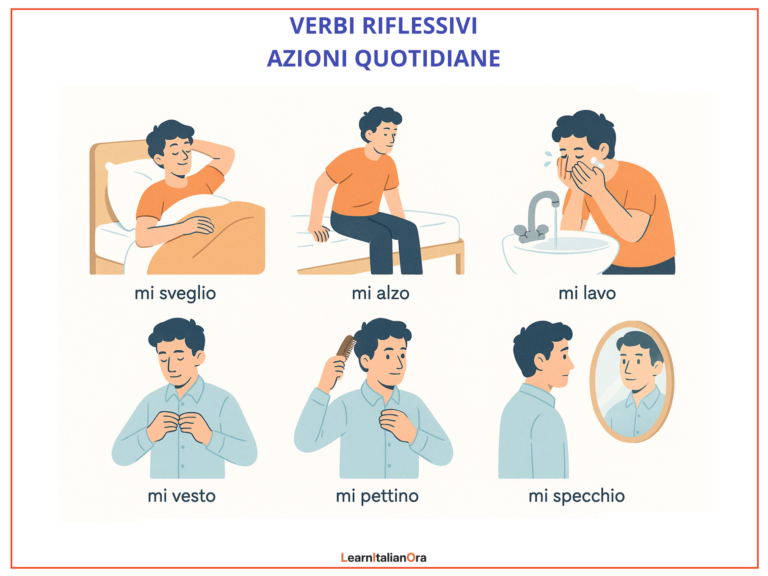
Every day we perform many everyday actions: we wake up, wash, dress, eat, work and go to sleep. But how do we describe these actions in Italian? Let's see together how to describe our day, step by step, using verbs that describe actions involving the subject.
Read more →
Grammar
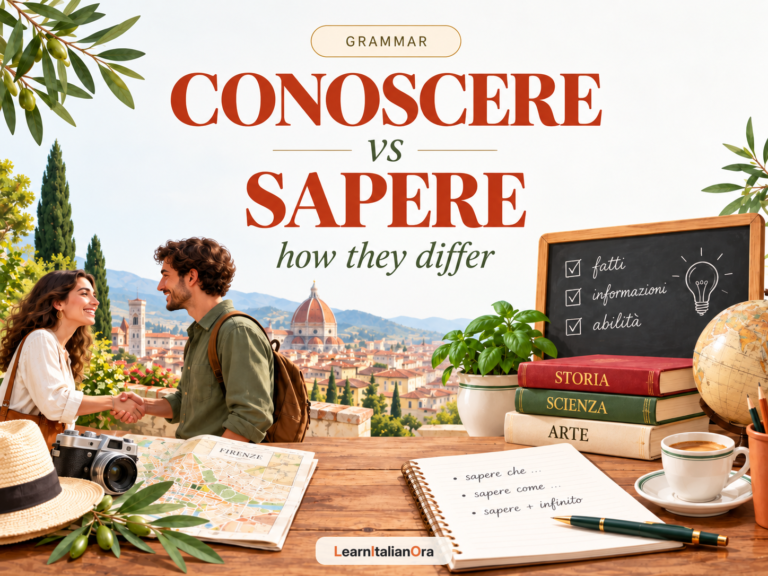
When learning Italian, one of the most common doubts is the difference between the verbs 'conoscere' and 'sapere'. These two verbs, although they can be translated as 'to know' in English, are used in different contexts and with different meanings. Understanding the difference between 'conoscere' and 'sapere' will not only help you avoid common mistakes, but will also allow you to express yourself more accurately and naturally. Let's look at the main differences between the two verbs and the contexts in which they are used.
Read more →
Grammar

Prepositions are small words that connect other words and show relationships such as place, direction or time. In Italian, prepositions of place are particularly important for beginners because they allow you to describe where something or someone is. In this post we will look at the most important prepositions of place used in Italian, with practical examples to help you understand and use them correctly.
Read more →
Grammar

Indefinite articles are used when we refer to a person or thing without identifying a specific one. Their form depends on the gender of the noun and on the first sound of the word that follows. They can precede either a noun or an adjective, and their forms change depending on whether the noun is masculine or feminine. The indefinite articles in Italian are UN, UNO for the masculine and UNA, UN' for the feminine. Each form is used in specific contexts according to the word that follows it. Italian indefinite articles follow similar rules to definite articles in the singular.
Read more →
Grammar
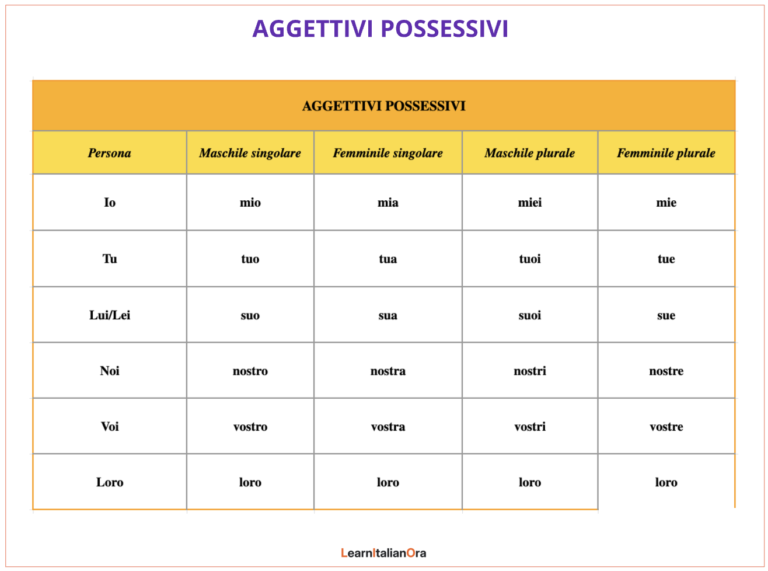
Possessive adjectives show who something belongs to. Forms such as mio, tuo, suo, nostro and vostro agree in gender and number with the noun they accompany; loro does not change.
Read more →
Grammar
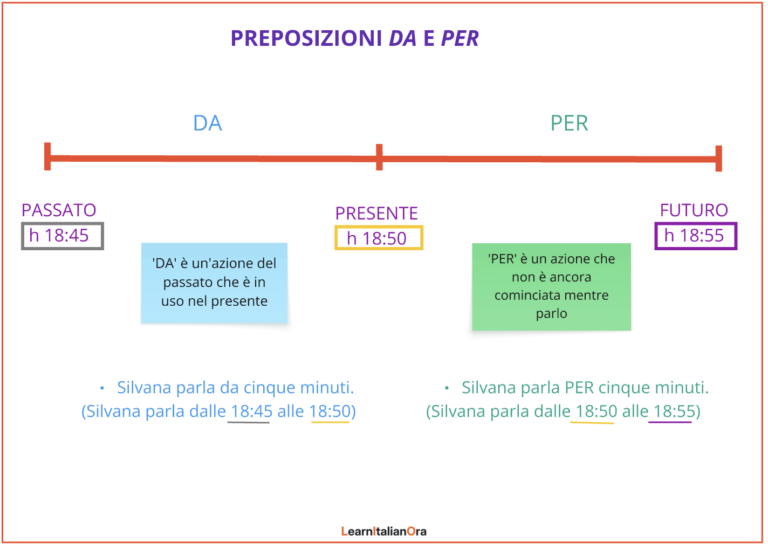
In Italian, the prepositions DA and PER are used to indicate the duration of an action, but they have different meanings and are used at specific times.DA is used when an action started in the past and still continues in the present.PER indicates how long an action lasts over a limited period. The action may be in the past, present or future, depending on the verb and the context.Let's see how to use them.
Read more →
Grammar

When we ask questions in Italian, question words help us to find out specific information: who (chi) is involved, what (che cosa) is happening, where (dove), when (quando) or why (perché).
Read more →
Grammar

If you are just starting to learn Italian, you have probably noticed that in this language words must 'go together'. This is called grammatical agreement, and it is a fundamental aspect of Italian grammar. Agreement is the relationship between words such as articles, adjectives and nouns, which must match in gender (masculine or feminine) and number (singular or plural). If it seems a bit complicated at first, don't worry! With a little practice and attention, you will be able to master it. In this article, I will take you step-by-step through how concordance works, using clear and simple examples. This is the perfect opportunity to improve your Italian and start building correct sentences right from the start. So let's roll up our sleeves and see how it works!
Read more →
Grammar
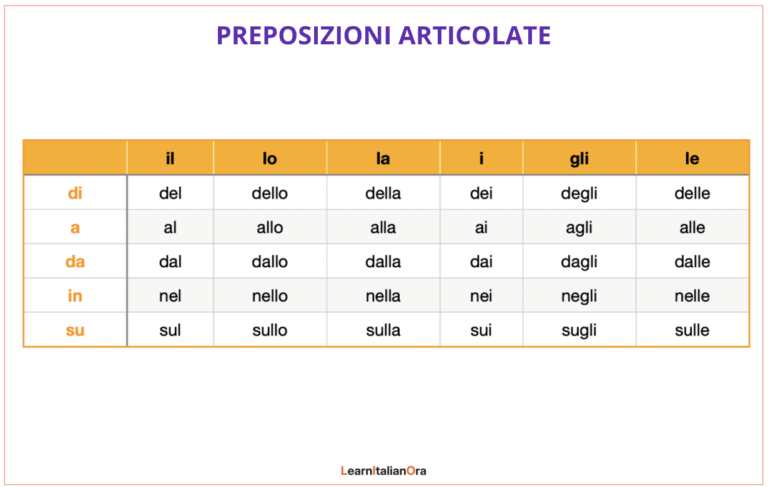
Prepositions are small but very important words in Italian. They are used to link words and sentences by giving information about a place, time, manner or cause. Learning how to use prepositions correctly is an essential part of speaking and writing clearly and precisely.
Read more →