In Italian, the prepositions DA and PER are used to indicate the duration of an action, but they have different meanings and are used at specific times.
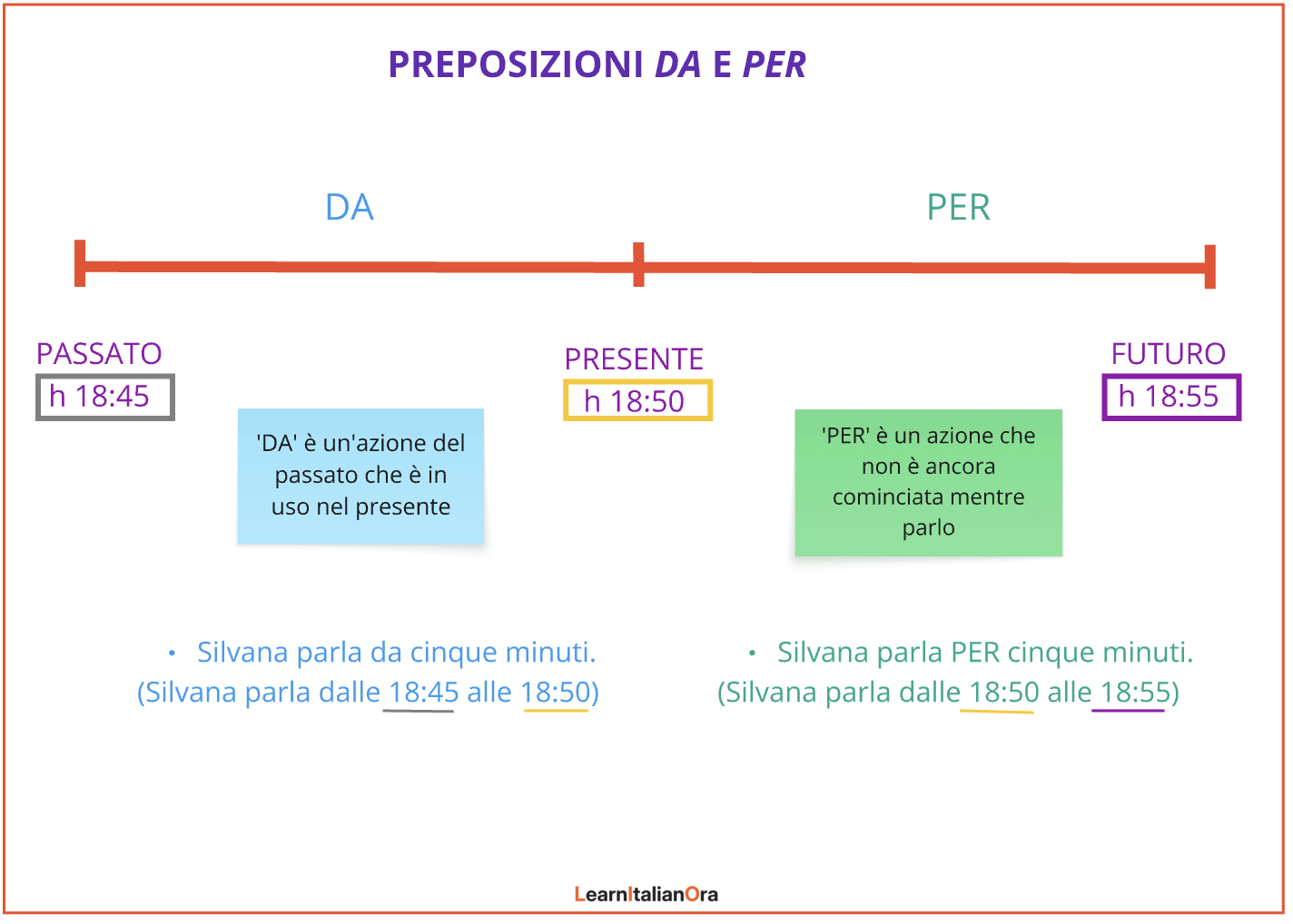
DA is used when an action started in the past and still continues in the present.
PER indicates how long an action lasts over a limited period. The action may be in the past, present or future, depending on the verb and the context.
Let’s see how to use them.
1. The preposition DA
The preposition DA indicates that the action started in the past and still continues in the present. The important thing here is that the action is not finished, it is still happening.
For example:
Da quanto sei in vacanza?
Sono in vacanza DA dieci giorni.
(The action of being on holiday started ten days ago and is still going on today).
Da quanto studi in Italia?
Studio in Italia DA due anni.
(The action of studying started two years ago and continues in the present).
Da quanto abiti in questa casa?
Abito in questa casa DA cinque anni.
(The action of living in this house started five years ago and continues in the present).
Dove vive Laura?
Laura vive a Parigi DA tre anni.
(The action started three years ago and Laura is still living in Paris at the present time).
2. The preposition PER
The preposition PER is used to express the duration of an action considered as a limited period.
For example:
Studio italiano PER due ore ogni sera. (I study Italian for two hours every evening.)
Here are some examples to help you understand the difference between DA and PER:
- Studio italiano DA due anni. (I have been studying Italian for two years: I started two years ago and I still study it.)
- Studio italiano PER due ore ogni sera. (I study Italian for two hours every evening: each study session has a limited duration.)
PER is used to indicate a duration viewed as a limited period.
To conclude
In conclusion, in order to correctly express the duration of actions in Italian, it is important to be able to distinguish between DA and PER.
DA allows us to emphasise the link between the past and the present, giving the idea of an action that has begun but has not yet finished.
PER, on the other hand, expresses how long an action lasts when the duration is viewed as a limited period.
Using these prepositions correctly will allow you to communicate more accurately and naturally in your everyday life.
See also prepositions A, DI and IN and simple and articulated prepositions.