Greetings are an important part of everyday interaction in Italian. The expression you choose depends on the time of day, the relationship between speakers and the level of formality. In this lesson, you will learn the most useful greetings for common situations.
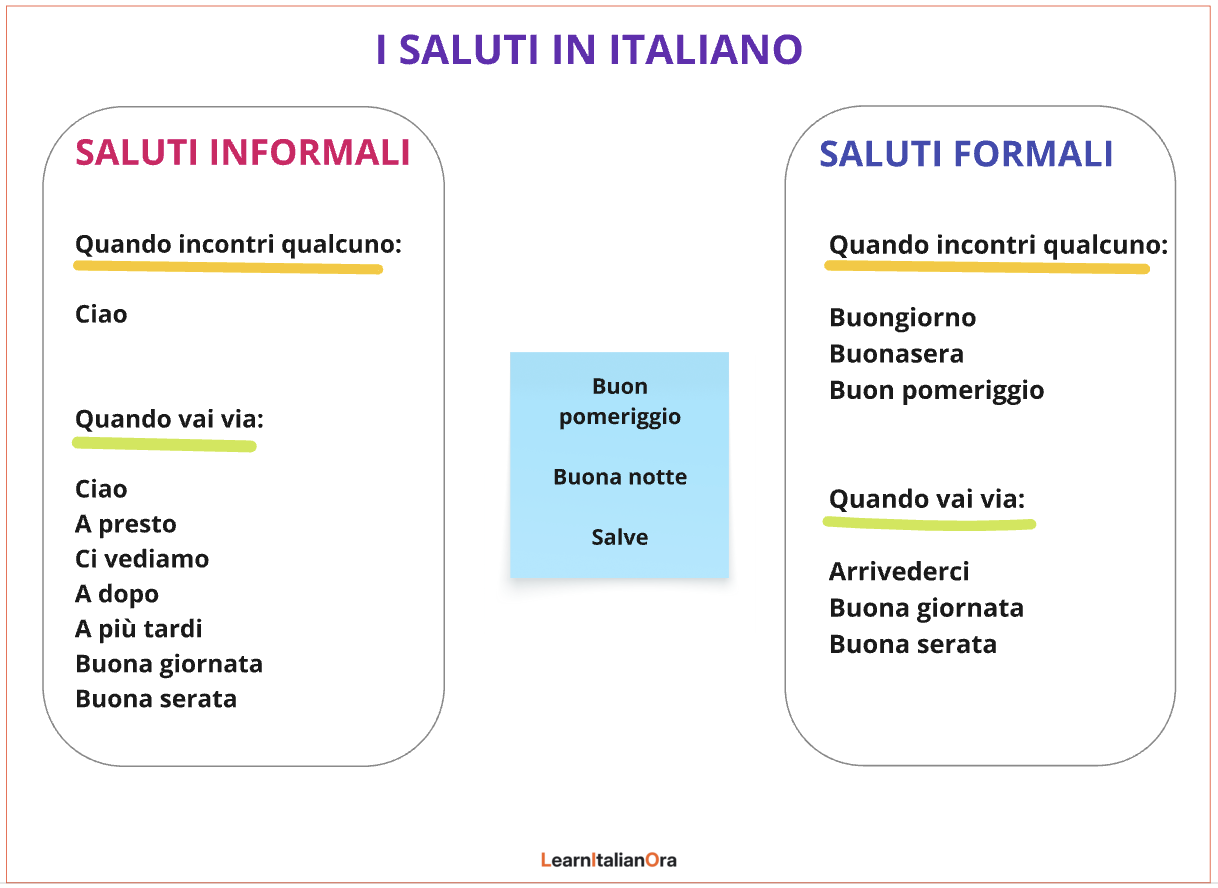
1. Greetings in Italian when meeting someone
Informal greeting
CIAO – This is the most common informal greeting and can be used both when meeting someone and when saying goodbye. Example: “Ciao, come stai?“
Formal greetings
BUONGIORNO – It is a polite greeting used from the morning; the point at which speakers switch to buonasera varies according to context and local usage. Example: “Buongiorno, signora Rossi“.
BUONASERA – It is used from late afternoon until late evening, it is the formal evening greeting. Example: “Buonasera, dottore“.
2. Italian greetings when leaving
Informal greetings
CIAO – Even when you are leaving, ‘Ciao‘ is the most common informal greeting Example: “Ciao!“.
A PRESTO – It is used when you expect to see each other soon. Example: “A presto, buona giornata!“
CI VEDIAMO – Informal and friendly, suggesting that you will see each other again. Example: “Ci vediamo, buona serata!“.
A DOPO – it is used when one expects to see each other again later the same day. Example: “A dopo, divertiti!“
A PIÙ TARDI – It is similar to “a dopo“, it is an informal way of saying that one will see you later. Example: “A più tardi, ciao!“.
BUONA GIORNATA – It is used to wish a good continuation of the day. Example: “Buona giornata!“
BUONA SERATA – It is used to wish someone a good evening. Example: “Buona serata!“
Formal greetings
ARRIVEDERCI – A polite or formal way to say goodbye. Example: “Arrivederci, signor Bianchi“.
3. Other useful greetings in Italian
“SALVE” is a time-independent greeting that can be used when arriving and, in some uses, when leaving. It is less formal than buongiorno or buonasera and is common when the relationship between speakers is neutral or not yet familiar. In clearly formal situations, buongiorno or buonasera is usually the safer choice. Example: “Salve, come stai?“; “Salve, come sta dott. Mario?“.
“BUONANOTTE” is used when leaving late at night and assuming the other person is about to go to sleep, either formally or informally. Example: “Buonanotte, ci vediamo domani“, “Buonanotte e sogni d’oro“.
4. Useful tips
- When in doubt, it is better to use a formal greeting, especially with people you do not know well or in professional contexts, regardless of the age of your interlocutor.
- In informal contexts, do not be afraid to be friendly and warm; Italian greetings often reflect the hospitality and cordiality of Italian culture.
I hope you enjoyed this first lesson on Italian greetings and found it useful! Follow me for more lessons and tips on the wonderful Italian language.
Practise what you’ve learned
Check your understanding, then try again if you need to.
Exercise 1 of 3
Choose the greeting
Choose one suitable greeting or farewell for each situation. More than one option may be correct.
You greet a friend when you meet. The time of day is not specified.
You greet someone politely during the day.
You greet someone politely in the evening.
You say goodbye to a friend. Choose a farewell that does not mention the time of day.
You leave a shop after a polite exchange with an assistant you do not know. Choose the usual general-purpose farewell.
You greet someone. The time of day and degree of familiarity are not specified. Choose a neutral or polite greeting.
Exercise 2 of 3
Choose the context
Choose the common use practised for each expression. These descriptions are not exclusive rules for all situations.
Buongiorno
Buonasera
Arrivederci
Ciao
A presto
Salve
Exercise 3 of 3
Complete the mini-dialogue
Complete each exchange by repeating exactly the same greeting or farewell used by the other speaker. In item 1, choose the expression repeated in B. Other replies may be suitable in real conversation.
A: ___, Marco! B: Ciao!
A: Buongiorno. B: ___
A: A domani! B: ___
A: Arrivederci. B: ___
A: Buonasera. B: ___
A: A presto! B: ___