In this lesson we’ll look at a basic aspect of Italian grammar: the three verb families. Known as -are, -ere and -ire verbs, these families are the building blocks of Italian verbs and serve as the basis for constructing sentences and expressing ideas. Understanding how each family works and how the verbs within it are conjugated is essential to speaking and writing Italian with confidence and accuracy. Whether you’re just starting out or want to deepen your knowledge, mastering these verb families will greatly enhance your ability to communicate in Italian. Let’s dive into the world of Italian verbs and discover how you can make your language skills even more solid and natural.
1. The three verb families
In Italian, verbs are divided into three main families. These are defined by the ending of the infinitive of the verb (verbo infinito), i.e. the basic form of the verb (the one we find in the dictionary). Here they are:
First conjugation – verbs in -ARE
This is the most common form. Verbs belonging to this family end in -are.
Example: parlare (to speak); mangiare (to eat); giocare (to play)
Second conjugation – verbs in -ERE
Verbs of the second conjugation end in -ere. Verbs in this family include:
Example: leggere (to read); vedere (to see); scrivere (to write)
The third conjugation – verbs in -IRE
Verbs of the third conjugation end in -ire. This conjugation has a peculiarity: it is divided into two sub-groups.
The first subgroup follows a regular conjugation, as in dormire (to sleep) and aprire (to open).
For example, in the present indicative we say io dormo, tu dormi, lui/lei dorme, noi dormiamo, voi dormite, loro dormono.
The second subgroup includes verbs that insert -isc- in some present-tense forms, as in capire, finire and preferire.
For example, in the present indicative we say io capisco, tu capisci, lui/lei capisce, noi capiamo, voi capite, loro capiscono.
2. Why is it Important to Know Verb Families?
Knowing the family to which a verb belongs is important because it helps you conjugate it correctly in different verb forms. It also allows you to better recognise and understand verbs when you encounter them in texts or conversations.
3. How do you conjugate regular verbs in practice?
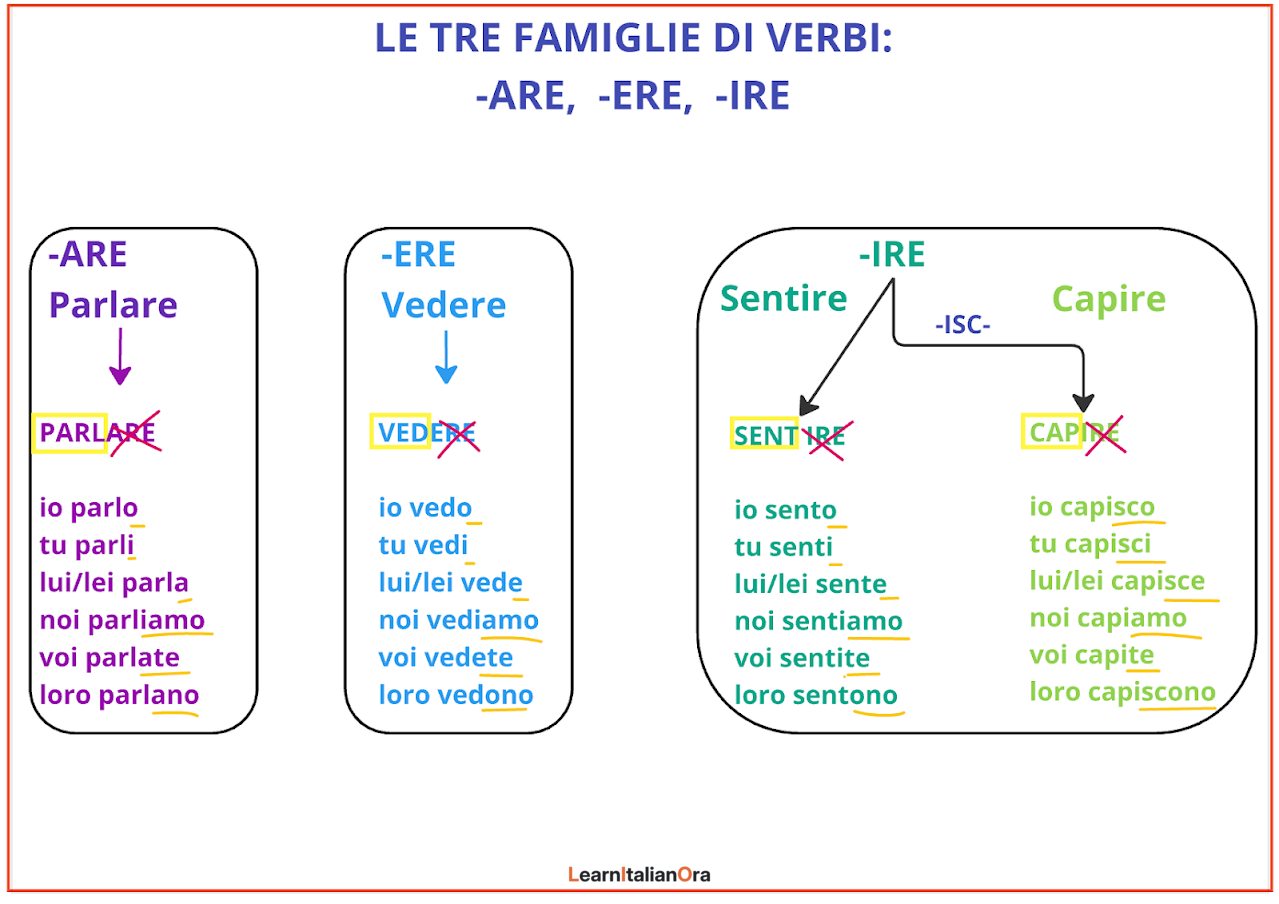
To conjugate verbs of each verb family, you must remove the final ending of the verb in the infinitive (-ARE, -ERE, -IRE) and add the appropriate endings in accordance with the pronoun (io, tu, lui/lei…).
Here is an example of how to conjugate the three verb families in Italian, together with a summary diagram that I hope will help you.
1. Parlare ( -ARE)
io parlo
tu parli
lui/lei parla
noi parliamo
voi parlate
loro parlano
2. Vedere (-ERE)
io vedo
tu vedi
lui/lei vede
noi vediamo
voi vedete
loro vedono
3. Dormire (-IRE, regolare)
io dormo
tu dormi
lui/lei dorme
noi dormiamo
voi dormite
loro dormono
4. Preferire (-IRE, con -isc-)
io preferisco
tu preferisci
lui/lei preferisce
noi preferiamo
voi preferite
loro preferiscono
These examples show the present indicative conjugations for each of the three verb families, including verbs of the third conjugation which require the addition of -isc-.
To conclude
The three verb families in Italian are the basis for constructing sentences and expressing ideas. Start practising with simple verbs of each conjugation, and you’ll see that with a little practice it will get easier and easier!
Practise what you’ve learned
Check your understanding, then try again if you need to.
Exercise 1 of 3
Which verb family?
Put each verb in the correct family: -are, -ere or -ire.
parlare
lavorare
studiare
leggere
prendere
scrivere
dormire
partire
sentire
Exercise 2 of 3
Present tense endings
Complete the verb in the present tense.
Io (parlare)
Tu (parlare)
Noi (credere)
Voi (credere)
Lei (dormire)
Loro (dormire)
Exercise 3 of 3
Complete the sentence
Write the correct present-tense form of the verb in brackets.
Io ___ italiano ogni giorno. (parlare)
Tu ___ molti libri. (leggere)
Noi ___ otto ore. (dormire)
Voi ___ italiano. (studiare)
Loro ___ il treno ogni mattina. (prendere)
Lei ___ domani. (partire)