If you are just starting to learn Italian, you have probably noticed that in this language words must ‘go together’. This is called grammatical agreement, and it is a fundamental aspect of Italian grammar. Agreement is the relationship between words such as articles, adjectives and nouns, which must match in gender (masculine or feminine) and number (singular or plural). If it seems a bit complicated at first, don’t worry! With a little practice and attention, you will be able to master it. In this article, I will take you step-by-step through how concordance works, using clear and simple examples. This is the perfect opportunity to improve your Italian and start building correct sentences right from the start. So let’s roll up our sleeves and see how it works!
1. Gender Concordance
In Italian, nouns and adjectives can be masculine or feminine.
For example:
Il gatto è nero.
The noun ‘gatto’ is masculine, so the adjective ‘nero’ must also be masculine.
La casa è bella.
The noun ‘casa’ is feminine, so the adjective ‘bella’ must be feminine.
2. Concordance in number
- Words must also match in number, i.e. whether they are singular or plural.
For example:
Il libro è interessante.
There is only one book, so ‘libro‘ and ‘interessante‘ are singular.
I libri sono interessanti.
Several books, so both ‘libri‘ and ‘interessanti‘ are plural.
3. General guidelines
Here are some general rules to help you:
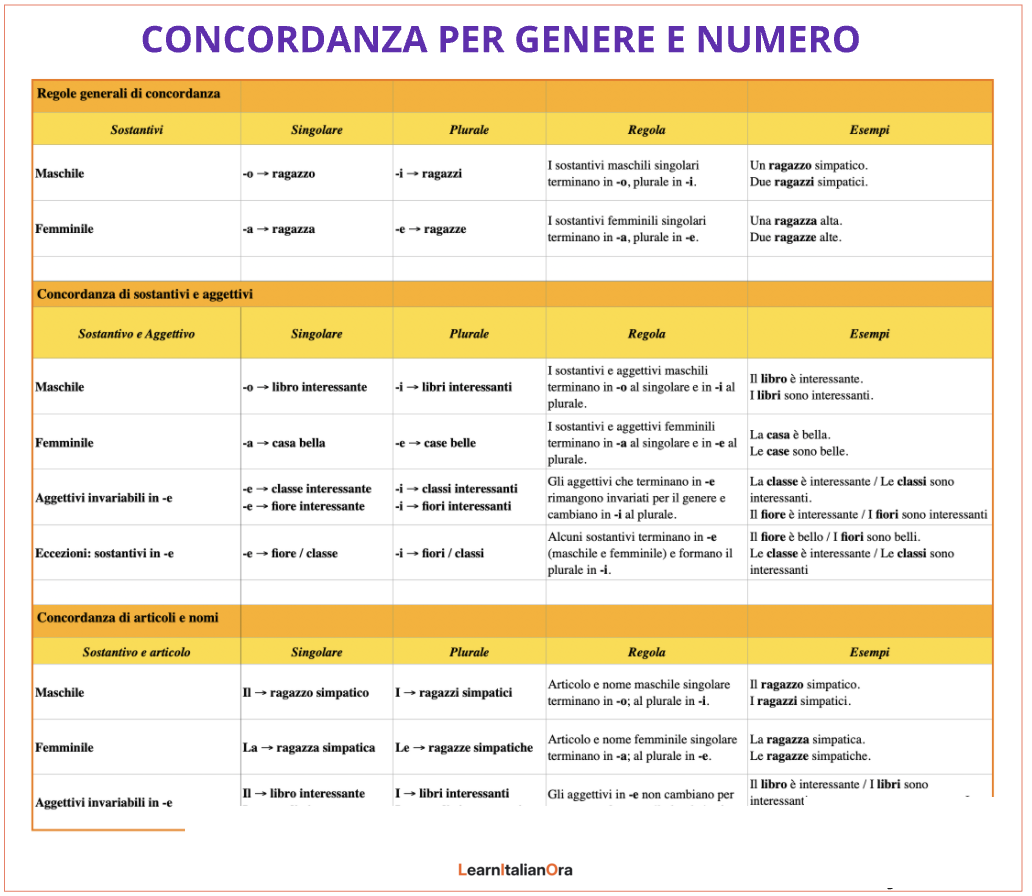
- Many masculine nouns end in -o in the singular and -i in the plural.
For example:
Un ragazzo → due ragazzi
- Many feminine nouns end in -a in the singular and -e in the plural.
For example:
Una ragazza → due ragazze
Many adjectives ending in -o follow the same four-form pattern: ragazzo alto, ragazza alta, ragazzi alti, ragazze alte. Adjectives ending in -e follow a different pattern, explained below.
4. Some exceptions
There are some words that do not follow the simple rules just mentioned:
- Nouns ending in -e can be either masculine or feminine; many form the plural in -i.
For example:
Un fiore (masculine), una classe (feminine) → due fiori, due classi
- Adjectives ending in -e
The reason why we say ‘il libro è interessante‘ and not ‘la sedia è interessanta‘ concerns a basic grammatical rule of the Italian language: some adjectives do not change form according to gender (masculine or feminine), but only according to number (singular or plural).
Adjectives such as ‘interessante‘ end in -e in the singular, and do not vary between masculine and feminine. This means that ‘interessante‘ is used for both masculine and feminine nouns.
For example:
Masculine singular: Il libro è interessante.
Feminine singular: La sedia è interessante.
In the plural, only the number changes. The adjective ‘interessante‘ changes only in the plural, becoming ‘interessanti‘ for both genders:
For example:
Masculine plural: I libri sono interessanti.
Feminine plural: Le sedie sono interessanti.
To sum up, the rule for these adjectives is that they remain unchanged in the singular and only change to -i in the plural.
To conclude
Concordance in Italian is a very important aspect of the correct construction of sentences, both spoken and written. Paying close attention to gender (masculine or feminine) and number (singular or plural) is essential to ensure that all the words in a sentence fit together and make sense.
It may seem tricky at first, but with a little practice you will find that it becomes more intuitive over time.
Don’t worry if you make mistakes at first – it’s part of the learning process! The more you study and practise, the easier it will be to recognise patterns and apply them correctly. Soon you’ll feel much more confident in your ability to form sentences with the correct concordance.
So keep at it and don’t give up! Remember, learning a language is a journey and every step forward is progress.
Practise what you’ve learned
Check your understanding, then try again if you need to.
Exercise 1 of 3
Make the adjective agree
Choose the correct adjective.
un ragazzo ___
una ragazza ___
due ragazzi ___
due ragazze ___
una casa ___
libri ___
Exercise 2 of 3
Singular to plural
Change each phrase to the plural.
il libro nuovo
la casa grande
il ragazzo italiano
la studentessa brava
il gatto nero
la macchina rossa
Exercise 3 of 3
Find the agreement error
Choose the correct sentence.